The tools of the job keep moving. The heart of it has stayed exactly where it was.
Pick up a book on leadership written this year, then find one written two thousand years ago. Strip away the language and you’re looking at the same argument. Somebody has to work out where a group of people is heading, and then bring them along. That was the task when it meant leading soldiers across a river, and it’s the task when it means steering a team through a reorganisation. The setting moves around. The core doesn’t.
We like to think our own era invented the difficult version of the job. Constant change, flatter structures, people who won’t simply do as they’re told. All of that is real. But the idea that leadership used to be easy is mostly a trick of distance. The people doing it at the time didn’t find it easy at all.

The advice is older than any company
Look at how far back the good thinking goes. Sun Tzu was writing about knowing your objective before committing a single soldier around the fifth century BC. Plato spent long stretches of The Republic asking who should be trusted to lead and how you would train them for it. Machiavelli’s The Prince, written in 1513, still gets quoted in boardrooms because its central worry, how a leader keeps authority when circumstances turn against them, never went away. None of these writers had a word for “management.” They were all circling the same thing we still care about, which is how one person gets a group to achieve something it could never achieve alone.
That is the part that hasn’t changed, and it’s worth being precise about what it actually is. Effective leadership starts with knowing what you want to achieve. Not a vague sense of direction, but a real outcome you can hold in your head and point other people towards. Every leader worth following in history had this, whether they were running a workshop or a country. They knew where they were taking people. Everything else, the tactics and the tools and the style, sits downstream of that clarity.
Why we believed leaders were born
For a long time the assumption was that this ability came bundled into certain people at birth. The Scottish writer Thomas Carlyle put the idea into its most famous form in his 1840 lectures, later published as On Heroes, Hero-Worship and the Heroic in History. His “great man” theory held that history was shaped by exceptional individuals who turned up already equipped to lead (Carlyle, On Heroes, Hero-Worship and the Heroic in History, 1840). It’s a flattering story, and it stuck around for the best part of a century.
Then researchers went looking for the traits these great leaders supposedly shared, and the story started to come apart. In 1948, the psychologist Ralph Stogdill reviewed more than a hundred studies that had tried to pin down the qualities that made someone a leader. His conclusion was uncomfortable for the great man crowd. The traits didn’t hold up across situations. Someone who led well in one setting often didn’t in another, and Stogdill argued that leadership grows out of the interaction between a person and their circumstances rather than from a fixed set of inborn qualities (Stogdill, Personal Factors Associated with Leadership, Journal of Psychology, 1948). Leadership happens between people, inside a context. It doesn’t sit finished inside one heroic skull.
That finding pushed the whole field in a new direction. Researchers moved on to studying what leaders do rather than what they are, and later to how the right approach shifts with the situation. But notice what survived all of it. The objective. The one constant running from Carlyle to Stogdill and everyone since is that leadership only means something when it’s aimed at a result. You lead towards a destination or you’re not really leading.
Why we assume it used to be simpler
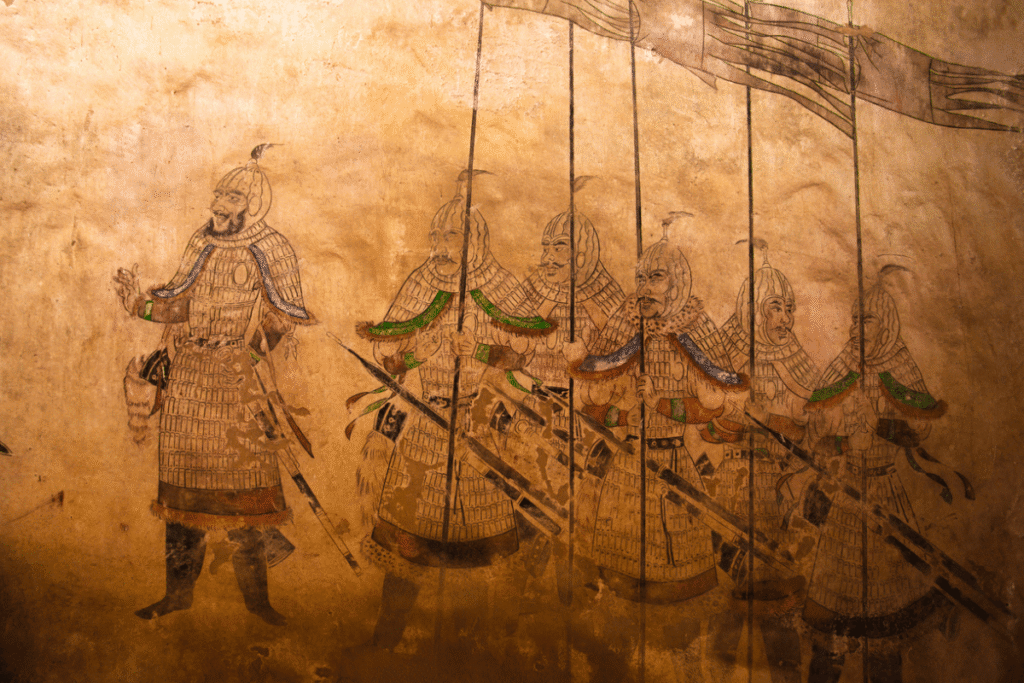
There’s a comforting story we tell about the past, that leaders back then had it easier because people just obeyed. It falls apart the moment you look at any real example. A Roman commander holding a legion together on a long campaign was managing exhaustion, fear, disease, pay disputes and the constant risk of mutiny, thousands of miles from home, with no way to call for instructions. A medieval abbess running a large religious house was balancing budgets, managing dozens of strong personalities, and negotiating with powerful men who’d have preferred she wasn’t there at all. None of that is simple. It was leadership under pressures we’d find hard to imagine, solved by people who understood their objective and knew how to move others towards it.
What’s changed isn’t the difficulty. It’s the source of the difficulty. Their problem was often physical hardship and blunt survival. Ours is more about winning genuine commitment from people who have options and won’t be bullied. Different pressure, same underlying task, which is why the best of their thinking still reads as current.

So what actually changed?
If the core is stable, the methods are where the movement happens, and the shift over the last century has been huge.
For most of history, authority came attached to the position. You led because you were the officer, the owner, the elder, the appointed one, and people followed because the alternative was worse. Obedience was more or less assumed. A leader could be cold and distant and barely competent and still get compliance, because the structure did the heavy lifting for them.
That world has gone, and it went fast. Deference to a job title has collapsed. Teams are more diverse and more mobile, often scattered across time zones and reporting lines. The people you lead frequently understand their own work better than you do, which makes “because I said so” not only unpleasant but useless. Getting a modern team to commit to something takes persuasion, trust, and a reason worth believing in. The order has been replaced by the case you make for it.
This is where the modern evidence gets interesting, because it shows just how much the “how” now matters. Gallup’s long-running research found that managers account for at least 70 per cent of the variance in team engagement (Gallup, State of the American Manager, 2015). The person in charge, and specifically the way they lead, is the single biggest factor in whether a team is switched on or checked out. And most teams are checked out. Gallup put the share of engaged employees at roughly 30 per cent in the United States and just 13 per cent worldwide (Gallup, State of the American Manager, 2015). The objective may be timeless, but the ability to rally people towards it has become the thing that separates leaders who get results from those who get quiet resignation.
None of this makes the old thinkers wrong. It makes them incomplete. Sun Tzu knowing his objective still matters as much as it ever did. What’s been added is that knowing it is no longer enough on its own. You have to bring people with you by choice rather than by rank, and that’s a harder skill than issuing orders ever was.

Back to the one question that counts
Every debate about leadership eventually circles back to a single question. Do you know what you’re trying to achieve? Get that wrong and no amount of charisma or technique will save you, because you’ll be leading people very efficiently in the wrong direction. Get it right and you have something solid to build on. The methods you use to get there will keep evolving, the way they always have. The need to know your destination won’t.
That is also why leadership can be taught, and why it always could be. If the job really came down to being born with the right traits, training would be a waste of time. The evidence points the other way. The constant skill, knowing what you want and being able to take people towards it, is learnable. The modern skills layered on top, earning trust and making your case to people who don’t have to listen, are learnable too. Nobody arrives knowing them. People get better through practice, through honest feedback, and through watching leaders who do it well.
It’s worth noticing how freeing this is. If leadership were a fixed inheritance, most of us would be stuck with whatever we were handed. Because it’s mostly a discipline, the door stays open. The manager who reads the room badly today can learn to read it well. The team lead who online leadership avoids hard conversations can learn to have them. History is full of leaders who were unremarkable early on and grew into the role because they kept working at the one thing that never goes out of date, which is knowing where they’re taking people and getting those people to want to come.
At Leader-Connect, that’s the whole premise. Our leadership courses are built around the skills that have always mattered and the ones the modern workplace now demands, taught by people who have actually led teams rather than only written about them. If you want to sharpen how you set direction and bring people with you, our online leadership development programmes are a good place to start.