Understanding your leadership style is really important, but whatever style you might have can always be developed and refined once it is understood. The most effective leaders are comfortable being themselves and they do not play a part in front of their team; this is what is referred to as authentic leadership, but to lead in this way requires a good level of self-knowledge.
The moods of a leader can have a disproportionate impact on those they lead, so leaders need to understand themselves well and what impacts positive and negative that they have on others. The leader should also work hard to understand the styles of other team members and use this information to structure and lead the team effectively. Strong teams, and especially strong leadership teams that build positive cultures will have a balance of different leadership styles within them. In order to understand your own leadership style as it is now, it is worth speaking with others that know you well and asking for their observation, but for this to work you need to value any criticism at least as much you value praise – it is the comments like ‘can be a bit harsh’ or ‘sometimes seem distracted’ that invite positive change.
You might think about doing a personality assessment of some sort. The Merrill Reid Social Styles tool is a very useful if basic tool for defining and reflecting your leadership style. This tool places people in one of four boxes in a quadrant: Amiable, Drive, Analyst or Expressive.
Follow this link to define your Merrill Reid profile:

You might also be interested to see Neil Jurd OBE’s video where he explains the model in more detail.
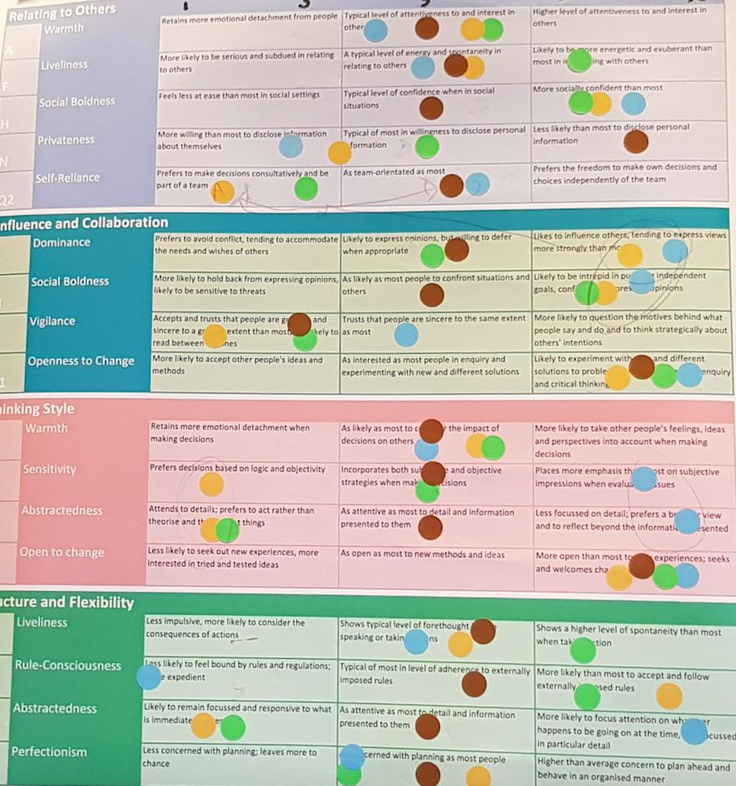
Other tools that might be useful to understand your leadership style include more formal 360 assessment, psychometric profiling and working with a leadership coach. It is possible to use psychometric profiling to help leadership teams understand themselves and others, and at Leader-Connect we often use the 16 Personality Factors psychometric to work with senor teams; it has a lot of useful detail and allows some discussion that you just couldn’t get to without the psychometric to open the door to honesty.
This in example of how 16PF can be used to look at team dynamic – each dot represents a different member of the team. The power in the discussion that flows from this process; the graphic summary is very effective for defining team strengths, weaknesses, alliances and clashes.