In my experience people use these terms as if they are the same thing, and this can be rather confusing. I first really understood just how common this misunderstanding is back in 2021 when an HR Director I had worked with before wanted my company to run some experiential leadership teaming for his senior leadership team in an innovative biotech company.
By this time I was already two years in to running an accredited experiential leadership course for a UK bio-tech company called Kymab (now part of Sanofi), and the programme was going very well. In the end the programme ran for five years until Sanofi closed down their UK lab site. So we were very well placed to run really impactful leadership training for a very similar company, and the course we were running had excellent reviews.
The final hurdle in the process with this new organisation for me was meeting the US based CEO, and the meeting was presented as a bit of a formality – but, right from the start it was very clear that what I called leadership training and what he called leadership training were not the same thing, and in fact not very much like the same thing. What he was after was management training; good, old-fashioned (and I really do mean old-fashioned) management training, with an extensive slide-deck and lots of mini-exams to pass.
Watch my video about the difference between leadership and management here:
What is Management Training?
If you are looking to train your managers in report writing, absence management or how to sign off claims on your internal IT system, that is management training. These sorts of things upskill a person so they can adequately fulfil the technical functions of their role. This sort of training is necessary; without it you will have chaos, but it is also likely to be rather dull and procedural; the sort of training that lends itself rather well to slide-deck-centric lectures, multiple choice final exams and mediocre delivery. This sort of course stabilises the world, but doesn’t change it, and this isn’t the sort of training that we offer. This sort of training can very adequately be given by a relatively unskilled but enthusiastic member of the HR or IT department. A Little Britain caricature of a trainer, very much ‘on send’, telling you the right answer, because management is a technical skill which can be uniformly applied. There is a right way and wrong way to fill in Form 1267A, and I’m going to show you it, then you’ll practice it, and then finally you’ll have to fill in the infernal form under test conditions.
Of course often when people ask about Management Training they actually mean leadership training, or more specifically, leadership training and development for managers. They want to develop the leadership skills of the people whose job tile includes the word ‘manager’, or possibly ‘supervisor, director, partner’ – but either way what they are after is a leadership course to make their leaders better at having a positive effect on people. Leadership training is always a good investment because it is usually the single easiest thing a company can do to have a positive impact. Good leadership will make the working environment a better place, and good leadership improves retention, recruitment, creativity and output. The only people who might resist good leadership are the HR Consultants who feast on the expensive tribunals and complaints that almost always have their roots in poor leadership. And, to be fair, poor leadership generally isn’t the poor leader’s fault – in almost every case nobody ever taught them to lead.
About Leadership Development Training
Leadership Development is something quite different. Of course it is, because leadership and management are quite different. As I wrote in my (bestselling – sounds cheesy, but it is) The Leadership Book, management is about stuff, leadership is about people. And more specifically leadership is about achieving more but engaging people in pursuit of a clear and compelling purpose. And it should buzz throughout the organisation, it isn’t the preserve of wiser and usually older senior leaders, it is an embedded and demanded mindset that people throughout an organisation all step-up to carry out regular and positive acts of leadership. And you can’t teach that sort of thing in a classroom. Of course they can be taught those things in theoretical terms, so they will be able to answer exam questions (In his bestselling ‘The leadership Book, how does popular and handsome British leadership author define leadership?). But knowing the answer is very different from being able to do the answer. That’s why some of the worst bosses in human history had MBA certificates on their office walls.
How Leadership Development Programmes should be run (IMHO)
Over many years of working in leadership development, working with leaders in all sorts of lines of work; secondary and higher education, pharmaceutical and bio tech, finance, logistics, cadet force leaders and pretty much every other sector, I have developed an approach to leadership development for managers that really works. And it is much less ‘tell’ and much more ‘allow’. My courses, which I run with a small team of very experienced experts, are based around the simple theory in The Leadership Book, and we then run practical experiential exercises which give delegates the chance to try out the theory. We call these exercises ‘Experiential Leadership Projects’ and they are very cleverly designed to present situations that require leadership and teamwork.

A typical project might be building a 20-metre roller coaster, or running a simulated business creating origami sculptures; the actual activity isn’t important at all, but the conditions we set around that activity are important and it is these that generate the learning. For instance, we might create a hierarchy with different levels of seniority, and a structure with different functions under different leaders. There is also likely to be time pressure, resource pressure and a varied understanding of the situation. There may also be a sense of competition with other teams working on similar tasks.
Experiential Leadership Development Projects and the all-important reviews
Each Experiential Leadership Project is then followed by a skilfully facilitated review, and this is where the learning and development really takes place. In line with the ideas in my 2023 TEDx talk, this is the ‘Pause’ where people reflect on what went well, what went badly and most importantly, what impact they had and why. Although some delegates are desperate to be debriefed by our team on how they did, we resist all requests for our opinion, and we create the conditions where group members give each other feedback on the positive and negative dynamics they felt: ‘when you smiled and told me it will be fine, that really calmed me’ or ‘when you put your hand up to stop me talking, that really shut me down’. We create the conditions that allow an honest conversation within team members that helps everyone to understand and refine their own impacts. Of course it takes some skill to make this work, just taking a team paintballing and hoping that somehow serves to develop better team skills or leadership is highly unlikely to work. But we are very good at this.
The role of a good facilitator in Leadership and Team-Development
I wrote some notes for facilitators a few years ago when I took over as Director Initial Officer Training for the Army Cadet Force. I inherited a team of around twenty staff, delivering leadership training for hundreds of youth leaders every year. We ran the courses at the Royal Military Academy Sandhurst, and being selected to work on this course was a prestigious appointment – Sandhurst was founded in 1802 and Winston Churchill trained there, albeit not as a Cadet Force Officer.
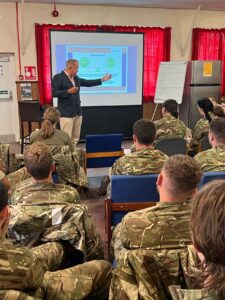
When I took over the course, I was stuck by the fact that it was a very managerial course rather than a leadership course, and that the instructors were at the centre of everything, delivering long PowerPoint ‘tell’ style lectures which presented the instructor as the master and the learner as the novice. Over the next few weeks I made significant changes to the way our team worked, bringing in experiential learning projects similar to the ones I use in my commercial leadership and management training courses, but perhaps more importantly was the subtle change to culture that I tried to create (and was fortunate to have a really great team who embraced these changes and worked very hard to learn and implement a different approach to leadership development).
But the biggest change was in the role and function of the instructor, who instead of being the star of the show moved back to become more of an artistic director or stage manager; creating the conditions that allowed people to learn leadership for themselves rather than take notes from an expert. So I suggested that they sit at the back of discussion circles rather than at the apex, encouraging delegates to talk to each other; that they resist the urge to ‘tell’, and instead learn to ask the right questions that set delegates thinking about what they did, how it went, why they behaved how they did, and how they might develop. The change was powerful; a leadership development course run in this way, one that nurtures learning rather than imposes it somehow elevates from normal time, it is immersive and delegates often find themselves in a state of ‘flow, where they are barely conscious of time. At the end of a module of one of our courses people generally can’t believe how fast the time has gone and how much they have learned.
Leader Connect founded by Neil jurd is a UK based leadership and team development company that use experiential learning supported by online leadership development videos and courses to deliver leadership training and development for businesses, school and universities.